Big Housing Bills to Follow in 2026
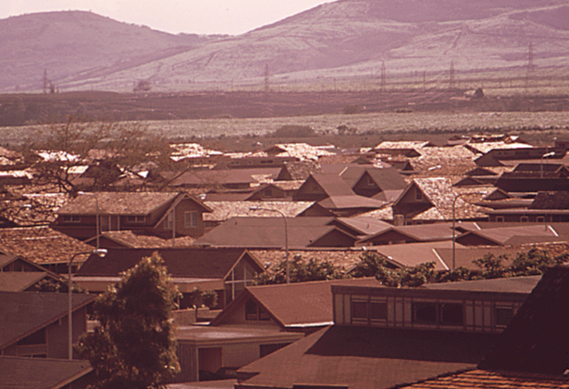
The newly constructed community of Mililani circa 1973. When Mililani was constructed, it offered thousands of residents new housing options. (Source: EPA)
Hawai‘i’s young residents need more housing options.
That means Hawai‘i needs more homes for young professionals starting their careers in these islands. Hawai‘i needs homes that are scalable for growing families. Hawai‘i needs homes in communities that with sustainable infrastructure in the coming decades.
Housing Hawai‘i’s Future has identified several measures that offer to advance our dual missions of increasing housing supply and securing housing stability for residents. These will be among the most important housing measures that advance through the body in 2026. These are the big housing ideas for 2026.
***
BROADEN PARKING FLEXIBILITY
Parking minimums create high housing costs, often adding $70k-$100k more per unit for residents. Removing parking restrictions allows builders to provide parking that fits residents' needs, preventing waste and generating walkable communities. The result is a two-fold affordability benefit for residents: less waste and a more affordable home. We will broaden parking flexibility (and decrease housing costs) with these measures:
HB1919/SB29: Effective 7/1/2027, this measure prohibits minimum off-street parking requirements for any new development in an urban district. It further requires each county to amend or repeal any charter provision, ordinance, code, standard, or administrative procedure that imposes a minimum off-street parking requirement by 7/1/2027. If enacted in 2026, county governments will have over a year to adapt.
HB1701/SB2356: This measure prohibits minimum off-street parking requirements for new developments or redevelopment projects located in transit‑oriented development infrastructure improvement program areas. It will take effect on July 1, 2027, meaning that counties will have a year to adapt to this proposal too.
***
RE-ESTABLISH THE INDIVIDUAL HOUSING ACCOUNT
Hawai‘i has the lowest rate of homeownership for those 35 and under in the nation. The IHA, established in 1982 to help residents deduct a portion of their pre-tax income for a down payment, needs to be updated to function as a meaningful tool for residents in 2026. Helping the workforce save means more locals staying.
SB2552/HB1837 will update the IHA program. For taxable years beginning 1/1/2027, the program increases the maximum annual deduction for contributions to, and maximum account levels for, individual housing accounts. While the program has not been adjusted for inflation in the past forty years, legislative leaders will be working to adjust this program to actually benefit prospective homeowners.
***
MAKE THE STATE BUILDING CODE WORK
We need to make it easier for folks to follow the Hawai‘i State Building Code. Frequent code changes and historically long permitting processes only add confusion among builders and government officials, adding delays and increasing housing costs for residents. The result is fewer, newer safe buildings and the same aging inventory of older homes.
HB1725 is a building code reform measure that functions as an omnibus for the entire building code process. Beyond extending the cycle to provide counties with greater flexibility, it also guarantees stability for homebuilders by fixing all applicable building codes, standards, and county amendments for the life of a building permit (subject, of course, to matters of health and safety). It further provides funding to the Building Code Council to accomplish these objectives. Moving the building code cycle from 2 years to 6 years means we can spend less time debating (already) good rules and spend more time actually building.
***
USE THE VALUE PER ACRE MODEL TO PLAN FOR INFRASTRUCTURE COSTS
Projecting the cost of infrastructure investments can be directly calculated with the Value Per Acre (VPA) model through data-backed tax-revenue projections. Funding VPA models helps counties make economically wiser infrastructure investment decisions that directly correlate with return on investment. Unlocking infrastructure means unlocking housing.
HB1726 requires the Office of Planning and Sustainable Development, in collaboration with other agencies, to study options for and coordinate the development of a shared statewide housing and infrastructure data platform to inform agency decision-making and state housing and infrastructure investments. It mandates the development of a model that assesses the fiscal impacts of development and regional infrastructure investments. To accomplish this objective, it also appropriates funds for OPSD to work with partners outside of state agencies.
***
RE-VAMP THE ‘201(H)’ PROGRAM
When the State established the Alternative Housing Pathways program (Act 38) in 2024, it was supposed to incentivize builders to expand workforce housing options for residents. To date, no developer has ever used this program to build a single home (or plans to). The program needs adjustments to make potential projects pencil while remaining attractive to residents. The AHP can be the main source of for-sale housing for Hawaii’s workforce - if we let it.
To make the AHP work, there is one notable pathway which merits attention in the 2026 Legislative Session. SB2424/HB1740 would remove the prohibition barring qualified residents from accessing state-approved projects. Currently, the prohibition barrs any such resident who holds a majority interest in land. These measures remove the requirement that qualified residents demonstrate financial viability or ability to pay rent. It will further amend the program to expand exemptions from statutes, ordinances, charter provisions, and rules for certain housing projects developed by the HHFDC that satisfy certain conditions, including requirements related to employment, owner-occupancy, and deed restrictions.
***
