What’s Happening with Bill 7?
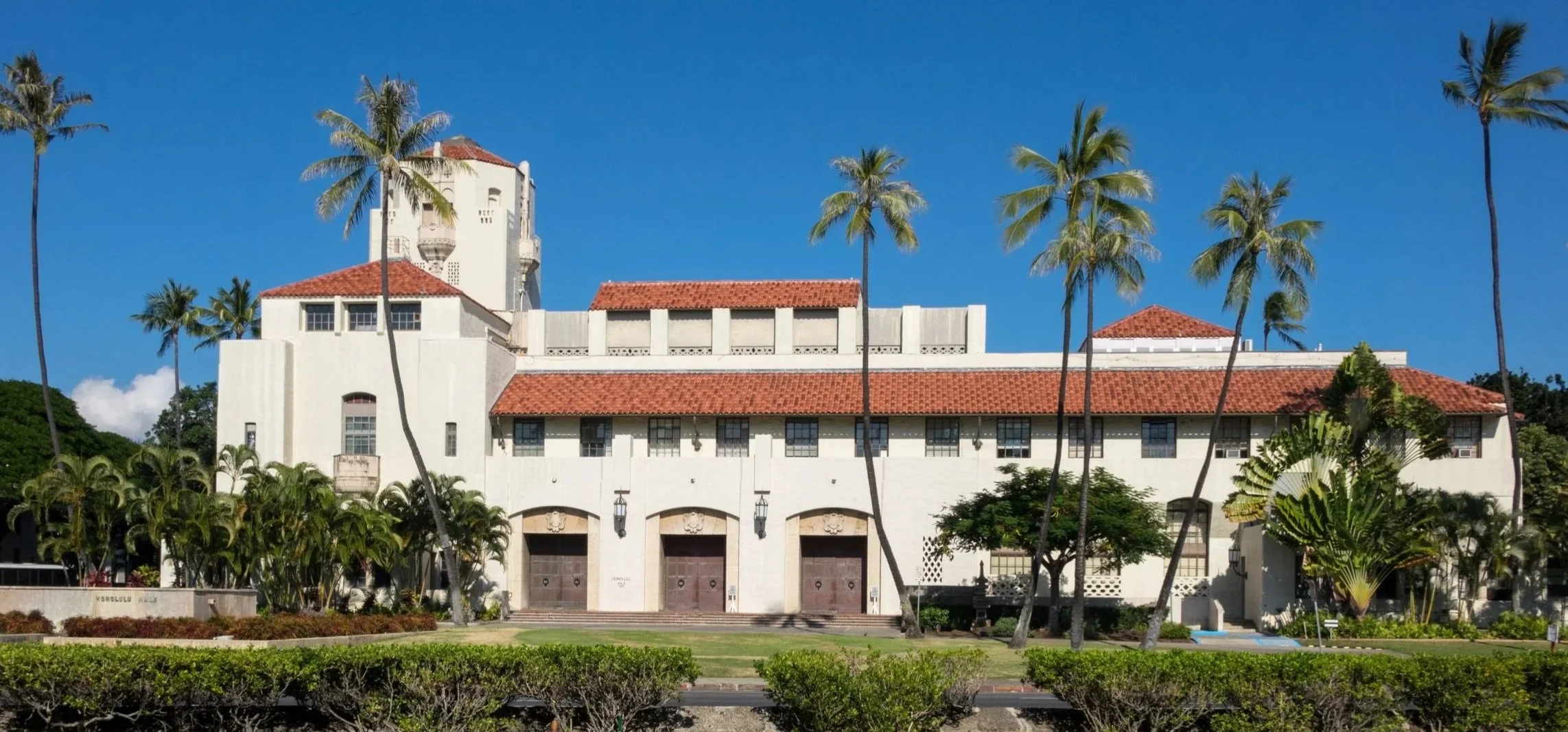
Honolulu Hale, which hosts the Honolulu City Council, Honolulu’s Mayor, and other county offices.
On March 5, 2026, the City and County of Honolulu’s Department of Planning and Permitting (DPP) provided a comprehensive overview of the county’s affordable housing program, known also as ‘Bill 7.’ The briefing was facilitated by the Committee on Zoning & Planning Chair, Councilmember Esther Kia‘āina, as part of efforts to provide more transparency about the state of the program.
The State of the Program
Known colloquially as ‘Bill 7,’ the City and County of Honolulu’s program is established under Chapter 32 of the Revised Ordinances of Honolulu (ROH). Bill 7 is a promising program for generating new housing options for residents.
While it has only resulted in 189 new rental units to date, DPP claims it could result in 1,752 new rental units for residents. However, the true mark of a project’s completion is whether or not it has received a certificate of occupancy (CO). Several projects finished construction, but they currently lack such a certificate. Critically-needed housing remains empty as a result.
Councilmember Andria Tupola has pressed for more transparency on why many completed buildings presently lack COs. “In the future,” she told DPP Director Takeuchi Apuna, “I do think we should also look at the timeframes of Certificate-of-Occupancy.’ I know we’re always ‘permit this, permit that,’ but after the permits are done [and] buildings are up, we still have this little delay with people unable to occupy readily-built buildings.” It was a problem that gained public attention in February 2026, when Honolulu Civil Beat reported on one building that had been vacant for ten months. It remains vacant to this day.
So far, housing projects have been completed in the following areas:
In Councilmember Matt Weyer’s district, one project has been completed in Wahiawa (Olive Avenue Apartments). This single project has generated 36 new units.
In Councilmember Tyler Dos-Santos Tam’s district, Pu‘uhue Apartments has produced 25 new units and 1060 Bishop has resulted in 52 new units. In total, these two projects have resulted in 77 new units.
Councilmember Scott Nishimoto’s district has seen three projects. To date, however, only three projects have been completed. 1427 Ernest Street resulted in 26 units, 1226 Kinau Street resulted in 25 units, and 1751 Algabora Street resulted in 25 units. In total, these three projects have resulted in 76 new units.
The Purpose of Bill 7 Projects
Bill 7 is based in existing urban hubs, and presents opportunities to revitalize accessible, mixed-use communities across O‘ahu’s towns. For now, much of this activity has focused on urban Honolulu, where housing demand is especially high.
Councilmember Kia‘āina wanted to know why the program has been largely concentrated in existing urban communities, most notably Councilmember Nishimoto’s district. DPP Director Takeuchi Apuna explained that this is driven by the spirit of Bill 7, which has traditionally pursued ‘in-fill’ in existing urban communities. “I think it would be because of the zoning in those particular council districts. They don’t have the apartment, business, mixed-use [zoning] where Bill 7 is intended for. So that is probably why developers aren’t looking for those parcels in their districts.”
In his most recent State of the City address, Mayor Rick Blangiardi’s administration has publicly praised the program. “For generations,” Blangiardi explained, “walk-up cinderblock apartments defined neighborhoods like McCully and Mōʻiliʻili, giving local families — including my own family, more than 60 years ago — a way to put down roots in our urban core. But over time, the cost of land and construction began to favor larger developments with more units, to help projects make financial sense.”
Mayor Blangiardi still believes in the Bill 7 program. However, if the Mayor’s administration is serious about increasing housing opportunities for residents, it needs to make it possible to get these projects finished (and occupied). Financing and infrastructure capacity will continue to make-or-break future projects.
The Future of Bill 7
To subsidize the construction of more housing units, the Bill 7 program offers both pre-construction and post-construction subsidies. Since 2022, the DPP has operated the post-construction grant program. However, they only began offering their pre-construction grant program earlier this year.
Logistically, pre-construction grants make more sense than post-construction grants, in large part because they facilitate speedier planning and construction among builders. “We believe the preferred grant, because you can only take either/or–is the pre-construction grant. I think they’re not looking at the post-construction,” admitted DPP Director Takeuchi Apuna.
For builders who need to raise financing to initiate home construction, the pre-construction grant is more important than the post-construction grant. Such pre-construction grants can assist builders with financing their projects, resulting in speedier construction (and lower costs).
There is room to expand to include for-sale projects for residents. It could also prove useful as a tool for adaptive reuse and mixed-use projects.
At least one project (1060 Bishop) successfully adapted an underutilized office building as a housing unit. Adaptive re-use can prove difficult, with Pew Charitable Trust noting that Single Room Occupancy (SRO) building types serve as a good route.
There are ways for Bill 7 to be improved. Such fixes could include the following:
Attracting engineers (through such mechanisms as loan forgiveness programs) to fill vacancies within the Department of Planning and Permitting;
Supporting pre-construction grants for builders
Expanding Bill 7’s reach to promote more mixed-use development and more accessible communities;
Examining ways to also provide owner-occupied units to qualified residents; and
Promoting single-room occupancy (SRO) style units is among the ways that Bill 7 could be improved in the future.
In the meantime, the University of Hawai‘i’s Economic Research Organization (UHERO) is conducting a thorough review of Bill 7. Their recommendations, which were recently furnished as a working draft to the City Council on March 27, will influence how the City Council weighs the future of the program in 2026 and beyond.
In spite of Bill 7’s stated goal of generating 500 new units for residents on an annual basis, there is no true, total number of homes that the city wants to generate through this program. Kia‘āina raises a real point. What is the true goal of Bill 7?
Furthermore, how does Bill 7 fit into the City and County of Honolulu’s broader efforts to increase housing options for residents?
***
Click here to view the actual briefing.
Click here to view a copy of the slides.
