
What Does “Affordable” Really Mean?
Titling a movement that carries different meanings
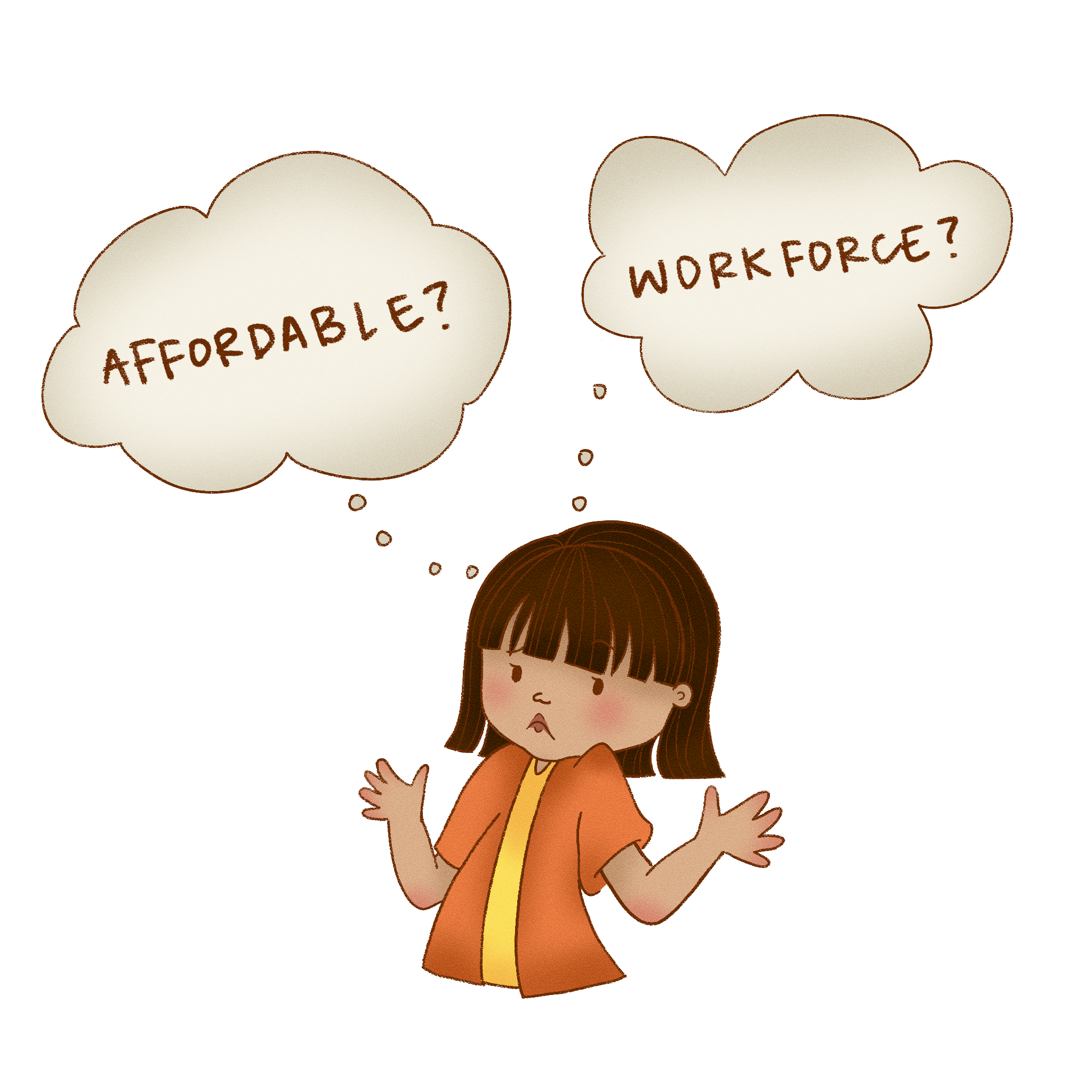
From the start of Housing Hawai‘i’s Future, our team has debated the wording of our movement—what do you call something that has a very specific meaning for different people? “Affordable” housing? “Workforce” housing? “Low Income” housing?
The definitions of these very specific terms mean different things to different people because they are subjective. For example, something considered affordable to someone working as a nurse for Hawai‘i Pacific Health might not be considered affordable for a cashier at Longs. It all depends on who is calling it affordable.
When we talk about “affordability” as it relates to housing, there are multiple definitions of the term: the personal definition, the U.S. Department of Housing and Urban Development (HUD) definition, the federal definition, and the state government definition.
Personal Definition

Let’s go back to the HPH nurse and Longs cashier example.
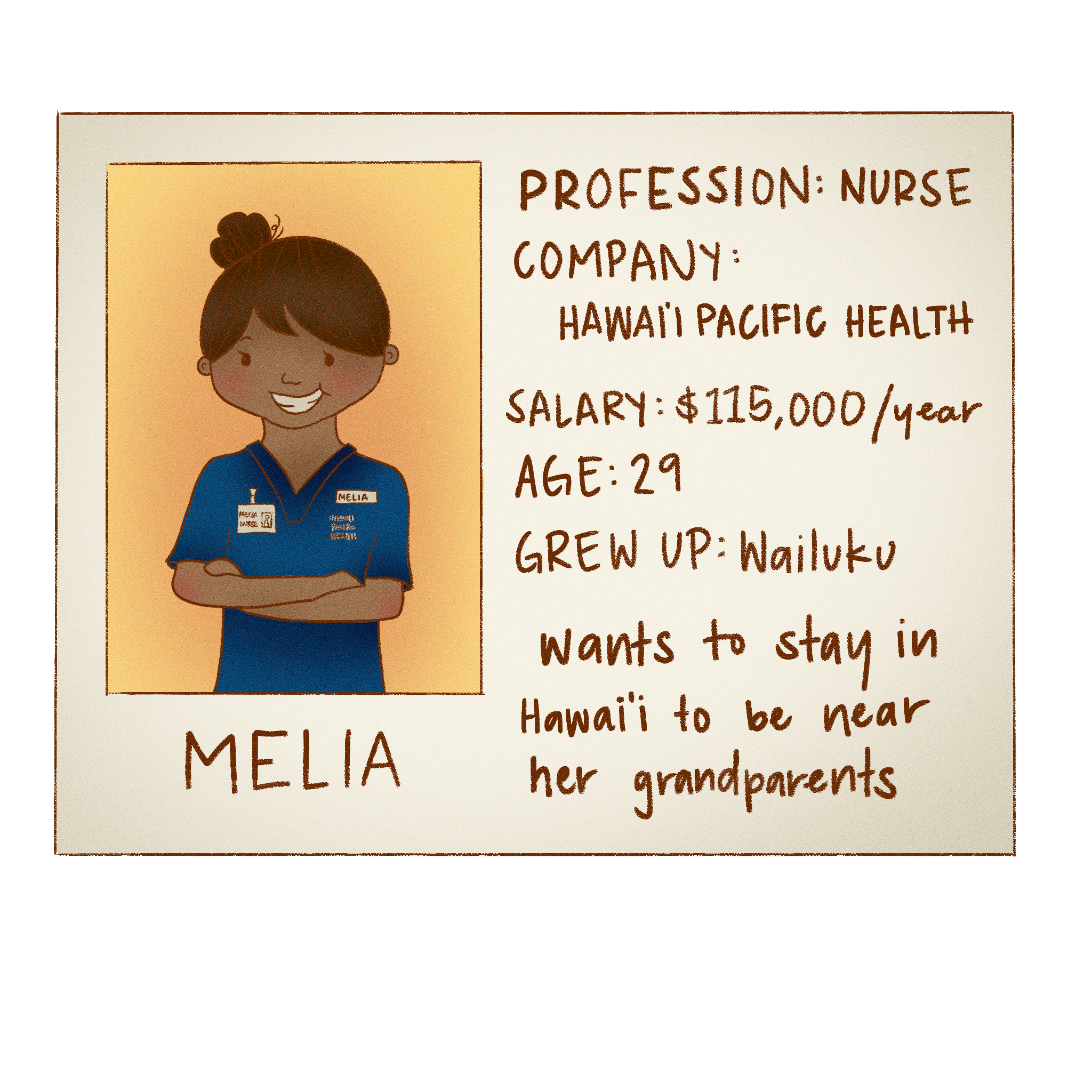
If Melia makes $115,000 annually as a Registered Nurse with Hawai‘i Pacific Health, her take-home pay would come out to about $3,415, according to Smart Asset’s Hawai‘i Paycheck Calculator. Let’s say that after Melia’s insurance, savings, and retirement contributions, her new take-home pay is $2,750 after taxes. If she gets two paychecks a month, then she earns $5,500 a month for her living expenses.
With this number in mind, Melia thinks it is affordable for her to spend up to $2,500 a month on housing, which includes rent and utilities. This is her personal definition of what is affordable, and everyone may have one based on where they work and how much they make.
Meanwhile, Melia’s friend Pono works at Longs as a cashier and makes $23 an hour. Assuming he works an average 40-hour week, his wage comes out to an annual salary of about $47,840. After his insurance, savings deductions, and taxes from his bi-monthly paychecks, his monthly take-home pay comes out to about $2,740. For Pono, he thinks it is affordable to spend $1,000 a month on housing—a very different number from Melia.
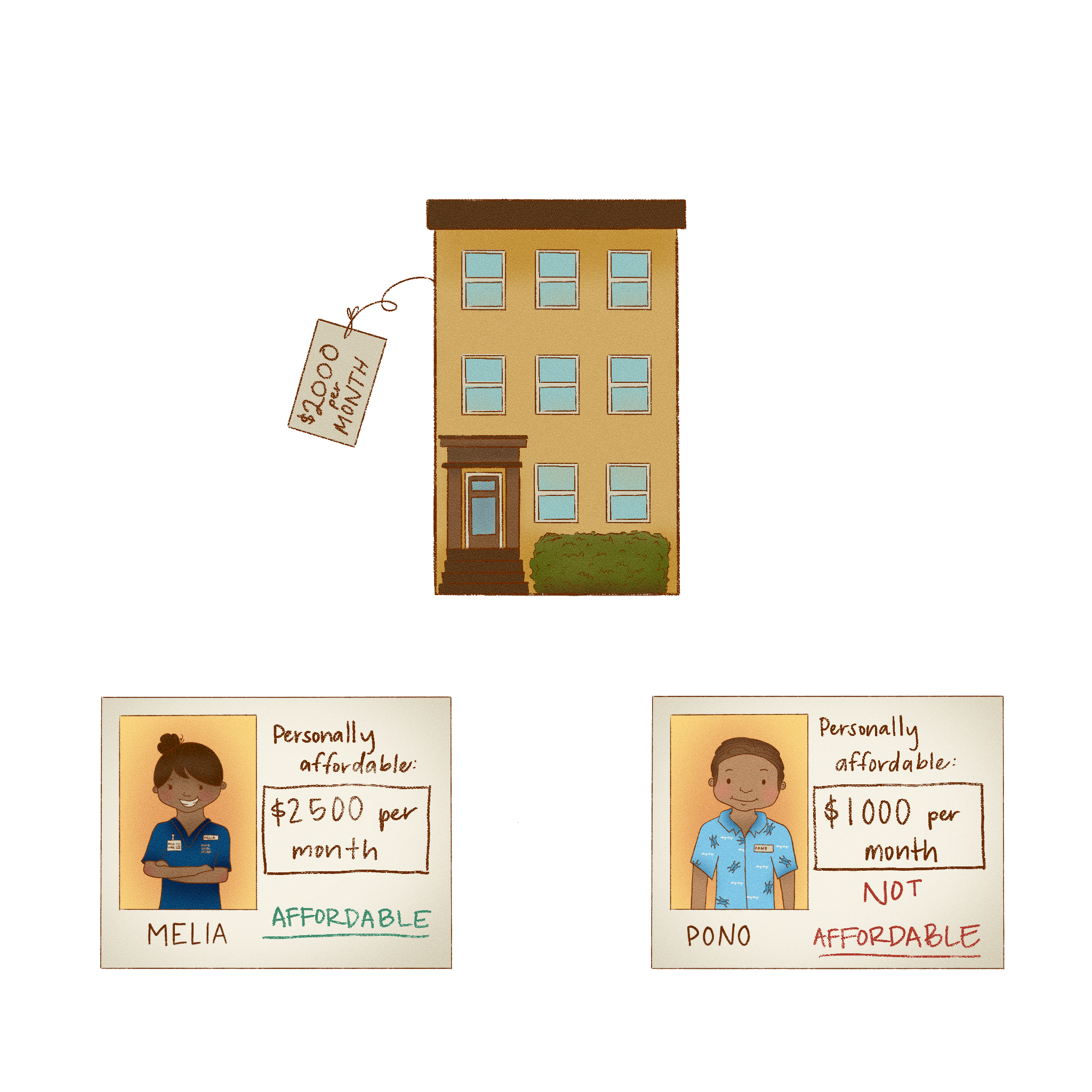
If both Melia and Pono were looking at the same rental property, which costs $2,000 a month, Melia might say that it’s a tight budget, but doable for her. Pono may see that number and call it unaffordable. When Pono sees that number that is unaffordable to him, he may consider reducing his paycheck contributions to retirement savings or health insurance to make that number more affordable, but he should not have to choose between having a retirement fund or housing in order to survive.
Regardless of what either Melia or Pono thinks affordability looks like, there are additional definitions set by both the federal and state governments—and even departments within each sector—that draw different boundaries for affordability.
HUD Definition
The standard that has been set by the U.S. Department of Housing and Urban Development considers housing officially cost-sustainable when a household spends no more than 30% of its income on total housing costs, including utilities.
For Melia, this means she should spend at most 30% of her $5,500 monthly income on housing, which totals to $1,650 a month—less than what she personally considered to be affordable. In Pono’s case, he should only spend at most 30% of $2,740 of his monthly income, which totals to $822 a month.
By the HUD definition, these amounts are what is considered “affordable” for Melia and Pono. If the two of them were looking at that $2,000 a month rental property now, neither one of them could call it affordable based on this definition.
Federal Definition
To understand the government definition of “affordable” further, we need to take a look at Area Median Incomes (AMI). AMI as a federal housing concept originates with the Housing Act of 1937 (Wagner-Steagall Act), which established income-based eligibility for public housing programs. The main goal of this act was to create safe and sanitary dwellings for low-income families, and the income limits were deliberately set low to prevent public housing from competing with the private housing market. AMI is the midpoint of a specific area’s income distribution and is calculated on an annual basis by HUD. With housing policy, it is used to determine benchmarks for eligibility with housing assistance programs.
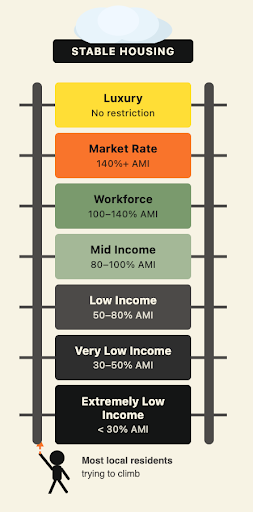
Based on where your income falls in relation to the AMI, you are eligible for different “affordable housing” programs categorized into four tiers: Extremely Low Income (30% or lower AMI), Very Low Income (between 30 and 50% AMI), Low Income (between 50 and 80% AMI), and Moderate Income (between 80 and 120 % AMI).
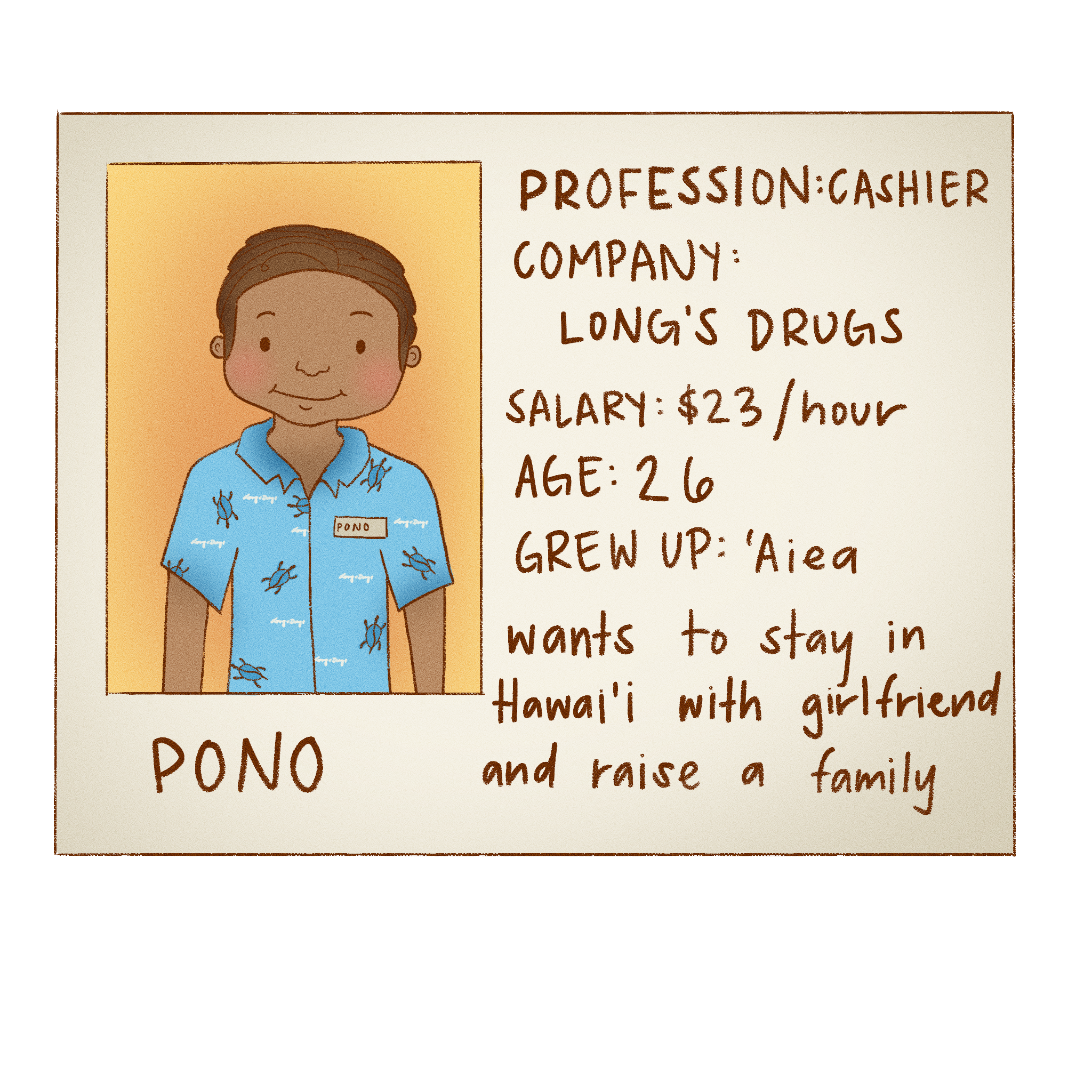
In Hawai‘i, the cost of living varies significantly between each county. For example, in Honolulu County for 2025, 100% of the AMI was $129,300 for a family of four. Melia’s $115,000 salary puts her at 108% AMI, or moderate income, as an individual household, while Pono’s $47,840 salary puts him at 45% AMI, or very low income, as an individual household.
State Definition
There is a flaw in the calculation of AMI. In Hawai‘i, HUD’s established AMIs vary greatly from county to county because median wages vary. But Honolulu County encompasses the entire island of O‘ahu, meaning the AMI is the same from Kailua to Nanakuli.
Because AMI is calculated using metro-wide geographies, high-income suburbs inflate the AMI for urban cores—making “affordable” units less accessible to the lowest-income households they're meant to serve. The 100% AMIs in each county are $98,300 for Hawai‘i County, $133,400 for Honolulu County, $120,100 for Kaua‘i County, and $148,000 for Maui County, with variation to the limits based on household size.
To complicate this dynamic further, the Hawai‘i Community Development Authority (HCDA) uses one AMI for the entire state, meaning it’s the same from Līhu‘e to Hilo: 100% AMI is $133,400 for a four-person household.
The Hawai‘i Housing Finance and Development Corporation (HHFDC) has Affordable Housing programs specifically for helping locals buy homes at below-market prices. Most of these programs target people in the 70% to 140% AMI range—what is essentially considered to be low to workforce income. HCDA also has a similar program called the Reserved Housing program, which targets people in the 80% to 140% AMI range.
The Low-Income Housing Tax Credit (LIHTC) that was introduced with the 1986 Tax Reform Act establishes 60% AMI as the benchmark for affordable housing, which is the most commonly used benchmark today across state and county housing programs.
Similar to the different AMI tiers used by the federal government, each of the state agencies (HCDA and HHFDC) use AMI metrics to define ranges of affordability. However, there is not one standard across the board, so it’s possible to qualify for one and not the other—which only adds to the confusion surrounding the term and enforces limitations that conflict even more with personal ideas of affordability.
Considering Melia’s $115,000 salary that puts her around 108% AMI, she would not qualify for the subsidized rent bracket for the LIHTC workforce population by the state’s 60% AMI baseline, but she could qualify for Reserved Housing programs. Pono, on the other hand, (with a $47,840 salary) would sit at 45% AMI and qualify for the LIHTC housing, but would not be within the target range for Reserved Housing programs. So, even with AMI, the definition of what is considered affordable and who qualifies for these programs depends on who is dictating the limits.

Housing Hawai‘i’s Future Definition
Given these varying definitions of “affordable” and the issue with AMI calculation, the term “affordable” really doesn’t encompass Housing Hawai‘i’s Future’s work.
We intentionally refer to our movement as being focused on “workforce housing.” This definition matches who we fight for—young locals, whether they are fighting to stay or finding a way back home from the continent. This workforce is key to everyone living in Hawai‘i because we are the ones driving the future of our communities—the businesses, the leaders, and the culture. From fishers in the tidepools or plantation workers to the modern-day Longs cashier or HPH nurse, the workforce has always been the backbone of the islands.
Whether you choose to say “affordable” or “workforce,” our movement aims to make housing that is attainable and accessible for young kama‘āina. We are talking about opportunities to make it possible for kama‘āina to stay in Hawai‘i and to keep building up the communities they grew up in. Whether you grew up in Hāna or Kīhei, whether you decided to continue with school or join the workforce after graduating, or whether you went to the mainland for college or stayed home for college, we created this movement for you—so you can stay.
We understand that these words can be misinterpreted or feel exclusive to people who fall into certain categories, but that is not what we are focused on here. We want everyone to have access to housing that they can afford, not just what is defined as “affordable.” It doesn’t matter how much money you make—if you want to keep yourself and future generations in Hawai‘i, you should be able to.