The ROAD to Housing Act
What the new federal housing law means for Hawai‘i, and how we get ready

What is the ROAD to Housing Act?
The 21st Century ROAD to Housing Act, passed in 2026, rewards states and counties that make it easier to build homes.
The law starts from a simple premise: the barriers to building homes look much the same from state to state. Parking mandates, restrictive zoning and slow permitting add cost and delay everywhere. So the law pushes states and counties to make it easier to build, and ties new federal funding to the places that can prove their housing supply is growing.
It has 59 sections across 12 titles. Most of it directs federal agencies. About 12 sections call for action by a state or county, and those are the ones that matter for Hawai‘i.

Federal dollars follow housing. Is Hawai‘i ready?
The rules come now. The money comes later.
Congress hasn't funded the law's new grant programs yet. But it has already decided how that money will be handed out: to the places that can show more homes getting built. When the funding arrives, Hawai‘i's counties will be judged on the reforms they passed and the housing they permitted in the years before they apply.
That's an opening for Hawai‘i. The barriers the law targets are the same ones keeping young locals from finding a home here: parking mandates, lot sizes that rule out smaller homes, and slow approvals. Fixing them makes it easier to build, and it makes our counties more competitive for federal money at the same time.
Waiting has a cost. Places that reform early start building their track record now. Places that wait will be competing against them.
1. A list of reforms

The biggest list: 18 zoning and permitting reforms HUD must publish as best practices for states and counties. They include reducing or eliminating parking minimums; allowing duplexes, triplexes and fourplexes by right; eliminating restrictions on accessory dwelling units (ADUs); standardizing, reducing or eliminating impact fees; and a state zoning appeals process.
Other important reforms on the list: the law also covers a public land database, equal treatment of manufactured homes, tying federal community development grants to housing production, single-stair apartment buildings, planning grants, the Innovation Fund, pre-approved designs, converting vacant commercial and industrial buildings into homes, federal funding for new affordable housing, and repair grants for low-income homeowners and landlords.

2. A reward for results
The Innovation Fund authorizes $1 billion over 5 years to reward measurable growth in housing supply. Applicants are scored on three years of housing data, and Hawai‘i's four counties can all apply.
Why 2027 matters: that three-year lookback is the key. Reforms passed in 2027 start building the record Hawai‘i's counties will be judged on when the money arrives. Passing reforms in 2029 puts us at the bottom of the list compared to thousands of communities applying across the U.S.
3. What changes when Hawai‘i acts
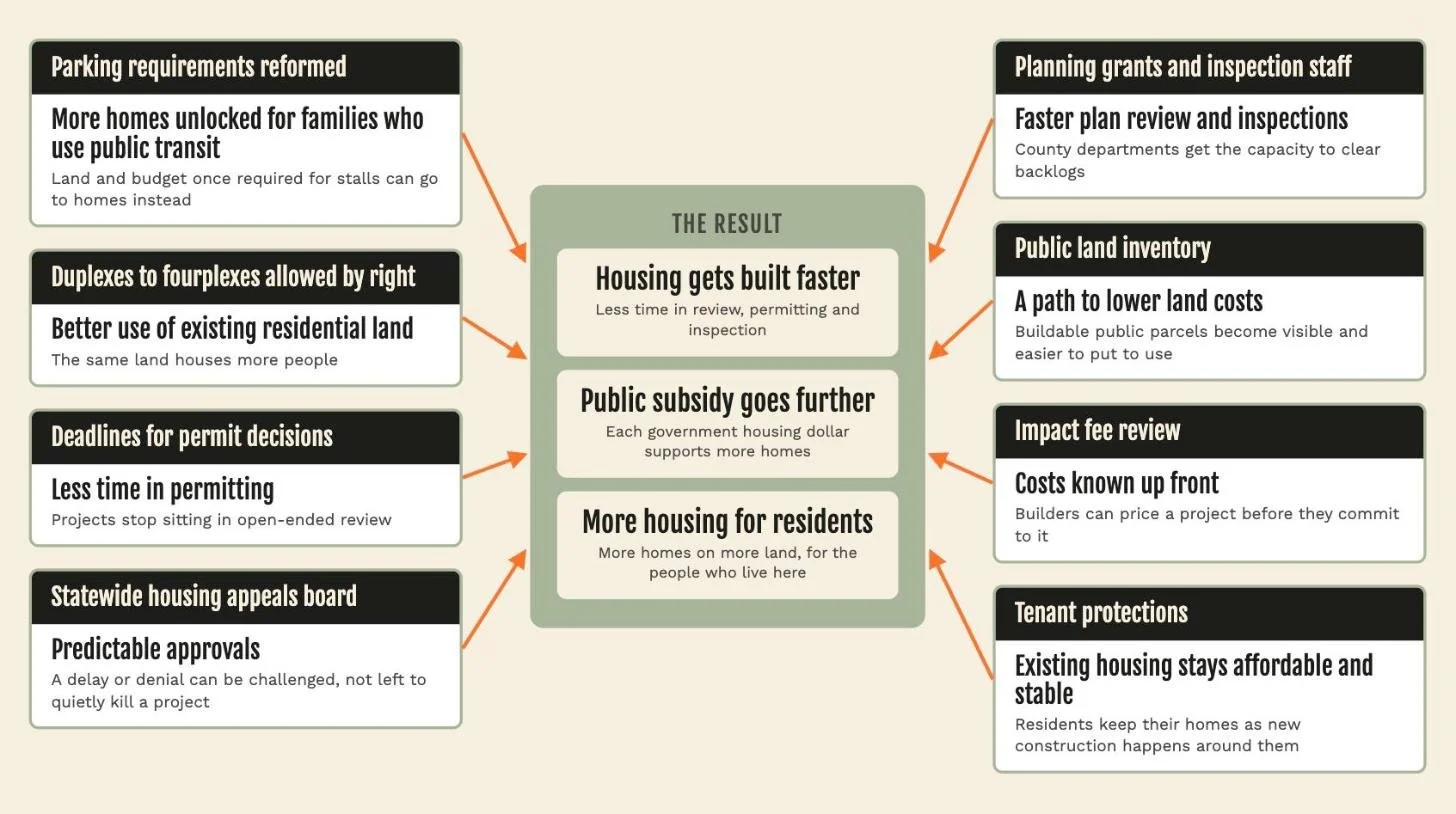
Each change in the package has its own effect, saving time or money at a specific step of building a home. Together, they add up to three results:
Housing gets built faster. Less time in review, permitting and inspection.
Public subsidy goes further. Each government housing dollar supports more homes.
More housing for residents. More homes on more land, for the people who live here.
"Jurisdictions that begin to update their zoning, building codes, and permitting policies now will be best positioned to win new grant funding."
Pew Charitable Trusts
Hawai‘i's response: the Housing Readiness Package
The Housing Readiness Package is 11 bills enacting these housing reforms, ready for the 2027 legislative session. It's a coordinated slate to tackle wholesale reform of our housing issues. Every bill ties back to the law's reform list and other key sections of reform, which means each one puts Hawai‘i closer to the record ROAD rewards.
1. Public Lands for Housing Act
Puts county-owned land that's suitable for housing on a public list, so it can be put to use.
2. Light Industrial Conversion Act
Opens light industrial zones to housing by right, while protecting the industrial land Hawai‘i still needs.
3. Missing Middle Housing Act
Legalizes duplexes, triplexes and fourplexes on urban-zoned land wherever counties allow residential lots.
4. Housing Supply Frameworks Act
Eases parking rules, allows smaller lots, opens public and church land to housing, and sets deadlines for permit decisions.
5. Wholesale Parking Reform Act of 2027
Removes off-street parking requirements for new housing in urban-zoned areas, with conditions.
6. Transit-Oriented Development Act of 2027
Does the same in county-designated transit-oriented development areas, where homes near transit need parking least.
7. Housing Appeals Board Act
Creates a statewide board to hear cases where counties delay or deny housing projects.
8. Ten-Year County Zoning Review Act
Requires counties to review their zoning every ten years, starting by December 31, 2030, so codes keep up with need.
9. Impact Fee Standardization Study Act
Has the State's planning office review impact fees in every county and at the state level.
10. Federal Housing Program Coordination Act
Makes the Office of Planning and Sustainable Development the lead agency for carrying out the ROAD to Housing Act in Hawai‘i.
11. Tenant Protection Act of 2027
Protects tenants and communities affected by new construction.

The Housing Readiness Coalition brings home builders, labor, business, finance, nonprofits, counties, legislators, and community groups behind one mission: to improve Hawai'i’s housing system.
WHAT COMES NEXT
Hawai‘i's housing shortage is a policy choice. The 2027 session is our chance to choose differently.
Source: 21st Century ROAD to Housing Act (H.R. 6644, P.L. 119-101), Secs. 102, 104, 107, 202, 204, 207, 208, 209, 210, 213, 301 and 1202. Quote: Pew Charitable Trusts.